
Sustainability: Batteries & Solar | Water | Heating
Batteries | Consumption | Battery Recharging | Solar Charging | How Long Without Sun? | Alternate Charging Options | Solar Regulators | The Bottom Line
See also: Lithium Battery Upgrade | Installing a Battery Monitor | Installing an Inverter
 With a couple of extended trips on the horizon, we took the plunge and invested in 2 x 120Ah Lithium (LiFePO4) batteries to replace our 2 x 100Ah AGM batteries.
One battery, or two?
We could have saved some dollars by replacing our two 100Ah AGM batteries (total ‘usable’ capacity of 100Ah) with just one 120Ah Lithium battery (‘usable’ capacity of 96Ah).
Yeah, right – never going to happen!
One 120Ah Lithium battery would have provided around the same stored energy capacity as the two 100Ah AGM batteries, saved some weight and given us the Lithium advantage of steady and consistent voltage – a lot of effort, and expense, for a minimal gain.
So, let’s get real here …… if we are making the effort to go to the well, why come back with the bucket only half-filled?
By replacing two 100Ah AGM batteries with two 120Ah Lithium batteries (connected in parallel) we have almost doubled our off-grid 12V energy capacity (total usable capacity increased from 100Ah to 192Ah) while more than halving our battery weight (62kg down to 25kg).
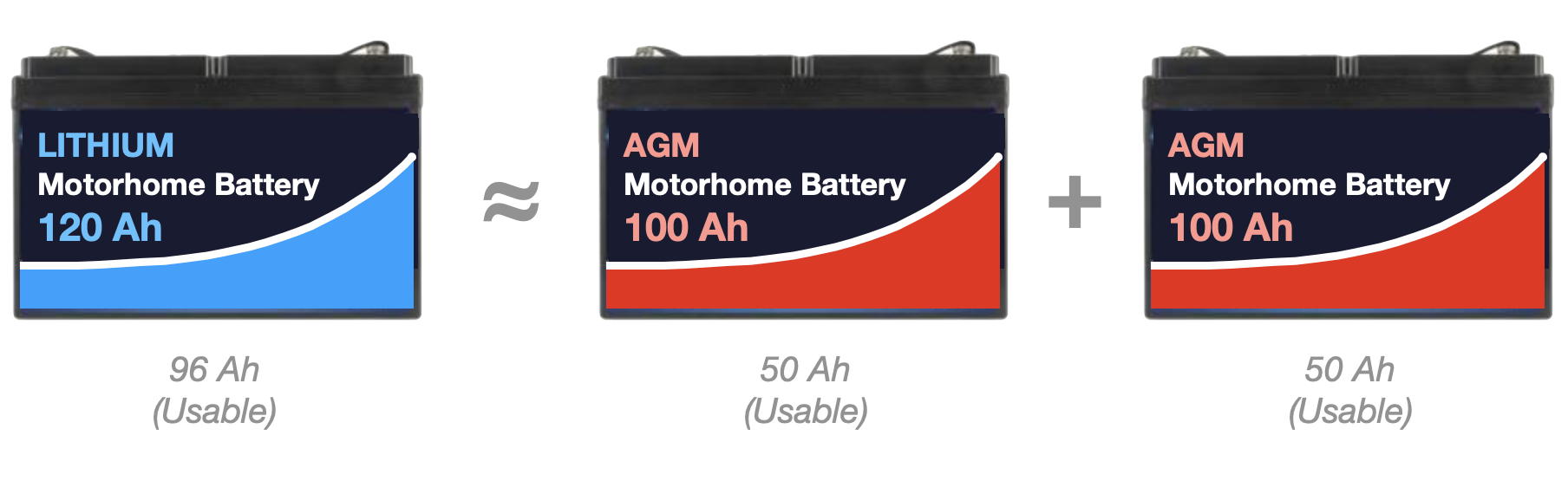
Of course, if your van has only one AGM battery, and that single battery generally provides adequate energy resources for your needs, then replacing that one AGM battery with one Lithium battery will provide a significant advantage, in both weight and 12V free-camping longevity.
If you are fitting out a new van, and you are planning on spending nights where mains power is not available, it is a no-brainer – Lithium batteries are the ONLY option.
Since completing our upgrade, larger capacity Lithium batteries have become more widely available – 200Ah and 300Ah – though they are also physically much larger than the 120Ah batteries. If you are replacing ‘standard’ size AGM batteries, ‘standard’ 120Ah Lithium batteries will fit neatly in the space occupied by the AGM batteries. Worth checking out the larger capacity batteries though if physical space is not an issue.
Important: Battery Storage Update (2023)
These regulations apply to the installation of electrical equipment in vehicles and relocatable accommodation, and apply to the RV Industry. In relation to battery installation, all batteries must now be installed in storage closets, similar to those used to store LPG bottles. These closets must be sealed off from the interior living space and have external ventilation. In addition to the storage location, all Lithium batteries will be required to have a battery management safety system, located not less than 600mm from the battery, designed to prevent over-voltage, over-current and excessive temperature changes. All batteries must be protected from short circuits or over-current situations through the installation of fuses or circuit breakers. All cables connected to the battery terminals must be connected at the terminals provided by the battery manufacturer. No more than four cables can be connected to each battery terminal.
|
 New Australian Design Rules for ‘Connectable Electrical Installations’ were released in November 2022. (Australian Standards AS/NZS 3001.2:2022).
Taking Charge
Lithium batteries are relatively expensive, but they are not the only expense involved in a battery upgrade. AC-DC and DC-DC chargers also need to be considered, along with the battery monitoring system.
While some battery suppliers suggest that AGM batteries can be swapped out directly for their Lithium batteries without any other upgrades, I feel that this may be more sales pitch than honest engineering advice.
The battery management systems (BMS) built into most Lithium batteries may do a satisfactory job of modifying the voltage that is being supplied by an existing AGM charger to suit the preferred input voltage of Lithium batteries. However, I remain to be convinced that a BMS is able to adjust the overall charging profile of an AGM charger’s output to suit the specific charging requirements of Lithium batteries.
I would also expect that installing charging devices with a tailored Lithium profile will contribute to a better long term outcome for battery performance and lifespan. A bit like feeding an athlete on takeaway food rather than a healthy tailored diet – they will survive, but not reach their full potential. My opinion only, of course!
 Our van was already fitted with a Lithium-capable Redarc 1240D DC-DC charger. All that was required to activate the Lithium profile was a change in the wiring at the rear of the charger – joining the green and orange wires.
We replaced our AC-DC charger – a CTEK MXS 25 – with a CTEK M25 model that has a Lithium profile. The new charger is exactly the same size as the old charger (including mounting screw location) which made for a very easy replacement. After powering up, the new charger auto-detected the Lithium batteries and adjusted itself appropriately.
Providing a neat conclusion to the upgrade process, a neighbour who was fitting out a van with a fridge for weekends away surfing purchased our AGM batteries and the AC-DC charger. This was a perfect setup for his needs, and a preferred outcome for us, avoiding a trip to the local recycling centre.
The Parallel UniverseCampervans and Motorhomes often have multiple batteries installed ‘in parallel’ to increase 12V electrical storage capacity.
Read more about connecting Campervan and Motorhome batteries in Parallel and in Series >>> |

Other considerations
 Continuous discharge current: This is an important consideration if you will be running 230V AC appliances through a power Inverter. A small 2-slice toaster, for example, will pull a continuous 70 amps from your battery/s.
Generally, a good quality 100Ah Lithium battery will be able to supply a continuous 100 amps of current, while a 200Ah Lithium battery will be able to supply around 200 Amps continuously. Some cheaper Lithium batteries have a lower continuous discharge capacity – around 50 amps for a 100 Ah battery.
Even with good quality batteries, I wouldn’t be keen to actually try discharging a battery at its maximum continuous discharge rate for an entire hour. Fortunately, the reality is that your toaster, microwave oven, coffee machine or hair dryer, connected to your battery/s through an inverter, will only be drawing continuous current at this rate for a minute or two.
Parallel battery connection can cumulatively increase the continuous current capacity of the battery bank. So, two batteries connected in parallel will double the continuous current availability of the individual batteries.
Check the specifications for the battery’s continuous/peak current discharge capacity, and the power requirements of any appliances that you may be running through an inverter.
-
- More info: Installing an Inverter in our Campervan
 Recommended charging current: One of the claims made by Lithium battery suppliers is the ability of Lithium batteries to be able to recharge very quickly – often quoting the charge rate to be the same as the capacity of the battery – ie, around 100 amps for a 100Ah battery. This is a maximum rate for a very short period of time (5 secs). The recommended figure in the spec sheets is the one to look for, and understand, in relation to the charging current supplied by your battery charger. This figure is usually in the 20 amps – 50 amps range.
And of course, this range of input current will only be achieved when charging your batteries from the vehicle alternator or a 230V charger. A single solar panel will likely be supplying less than 10 amps in ideal conditions – in reality often much less.
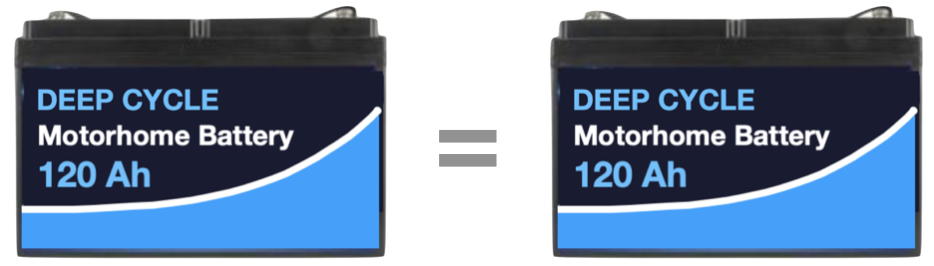 Parallel balance: Batteries in a parallel setup must be the same capacity and age as each other. (Even, ideally, being from the same production batch, according to the battery gurus.) Before fitting the new Lithium batteries in our van we fully charged each battery separately (overnight on a 230V charger), so that they had the same level of charge when first connected.
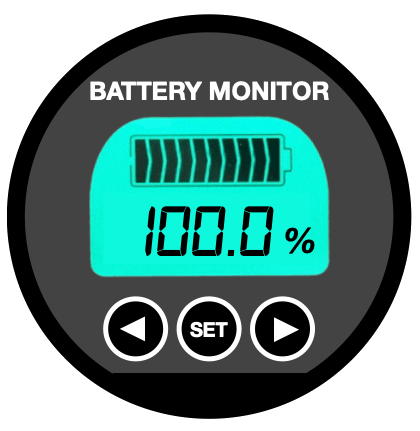 Battery Monitor: Our ‘control panel’ console initially had a voltmeter installed. A voltmeter is very much a standard option in most Campervans, and was OK for displaying the voltage of the AGM batteries, and in turn providing an estimate of the batteries’ State of Charge (SoC). However, the much smaller voltage drop of Lithium batteries over their discharge range makes a voltmeter impractical for determining the SoC of Lithium batteries.
As part of the battery upgrade process we fitted a more comprehensive ‘Coulomb counter’ battery monitor, which is able to accurately measure the SoC, and many other parameters of Lithium batteries. (Be sure to calibrate your battery monitor to accurately reflect the capacity of your batteries.)
-
- See also: Installing a Battery Monitor >>>
Which battery?
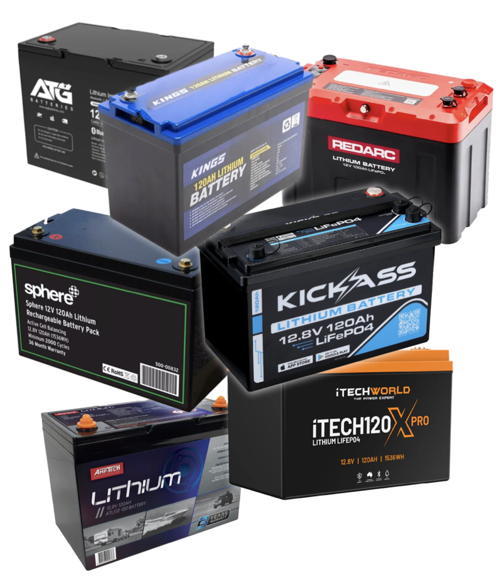 There are plenty of good quality Lithium batteries from which to choose these days.
After much looking around, we ended up installing 2 x Sphere 120Ah Lithium batteries. The Sphere batteries are widely used in the caravan industry, have a similar spec sheet to many others, and we could purchase them at a reasonable price from a friend in the industry. We have been using them now for 5 years, and they have been excellent.
Five years ago, when we were doing our update, there were only a few ‘quality’ batteries available. Now there are many more options. Check the specs, read the reviews, and consider the warranty – and how easily accessible the supplier might be if there is an issue. ‘Local’ is a good thing!
Here are a few to check out….
-
- Adventure Kings
- ATG
- Dune (Anaconda)
- iTechWorld
- KickAss
- Redarc
- Sphere
- and probably plenty of others!
Avoid the cheapies on eBay. The most critical component of a Lithium battery, along with the quality of the actual cells, is the Battery Management System (BMS) – the built-in chip that manages a battery’s charging and discharging regime. This is particularly important when considering the use of an inverter, where there is likely to be a heavy continuous load.
Size does matter
When we were shopping for batteries to upgrade our existing 2 x 120Ah AGM battery installation we stuck with 2 x 120Ah Lithium batteries, because they were an easy fit in the existing space. And bigger batteries weren’t an option.
Most suppliers now also offer 200Ah and 300Ah batteries. These might be an option to consider if you have the physical space available to fit a larger battery.
-
- (Update) Adventure Kings 120 Ah Lithium batteries are now available for under $320 on their regular ‘specials’ cycle. This looks to be a good budget-friendly Lithium option.
- Kings also supply 200 Ah and 300 Ah Lithium batteries which may be an option in a Campervan installation. (Though the physical size of these batteries may not be suitable for an ‘upgrade’ from previous 120 Ah batteries.)
- Check out this video review of the Kings Lithium battery (Aussie Arvos).
- (Update) Adventure Kings 120 Ah Lithium batteries are now available for under $320 on their regular ‘specials’ cycle. This looks to be a good budget-friendly Lithium option.
Cabling tidy up
The battery swap also provided an opportunity to tidy up our battery cabling.
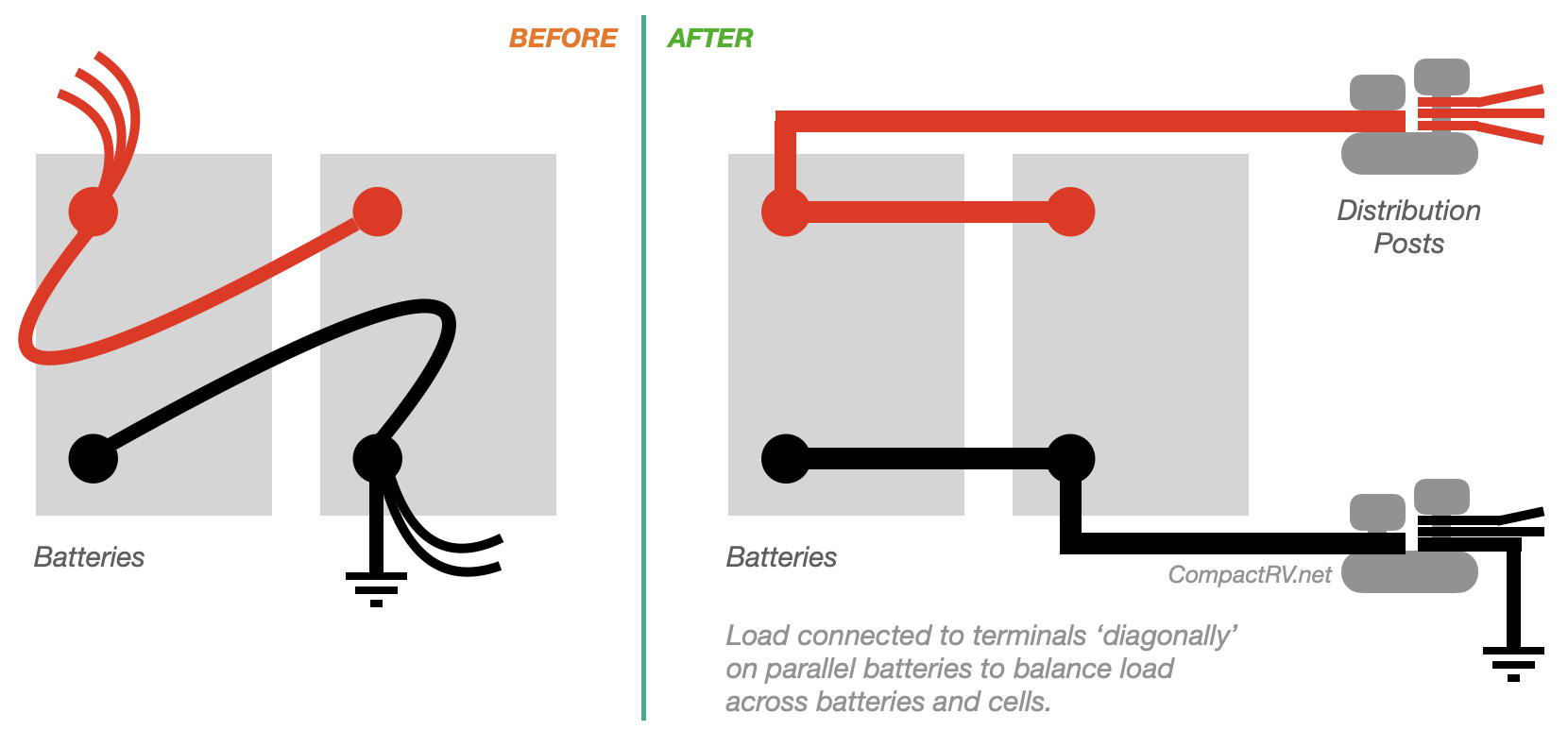
We replaced the existing cables between the parallel batteries – 6 B&S (16 mm²), 600mm long – with heavier and shorter cables – 2 B&S (32 mm²), 250mm in length.
We also installed a couple of dual distribution posts adjacent to the battery compartment (Jaycar, $12). All appliance and charger cabling is now connected to the distribution posts, which are connected to the batteries with heavy gauge (2 B&S) cables. These cables are readily available in various lengths in the battery section of your local auto parts store for around $20. Though for some unknown reason, red cables are difficult to find in auto stores. Black and blue seem to be the popular colours.
-
- See also: Dune Battery Linking Cables >>>
Battery Storage & Cabling Connection
-
- Note: New Australian Design Rules regarding the storage and connection of batteries in Campervans and Motorhomes have been introduced since the information below was published. Refer to the update panel above.
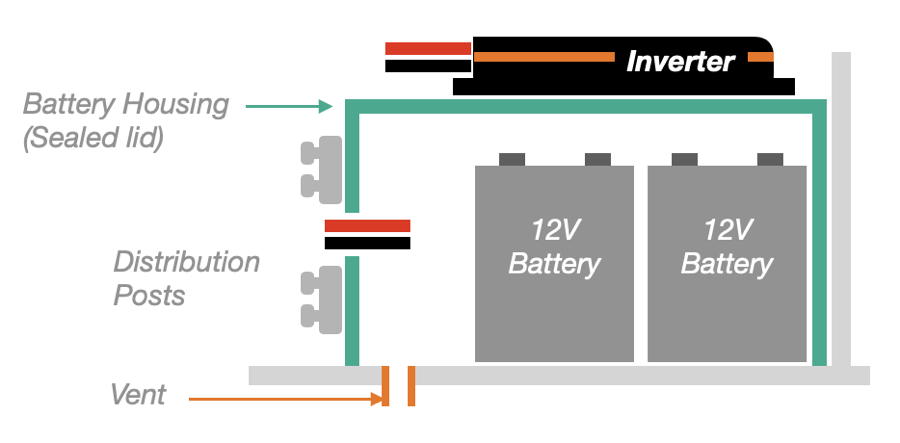
Our original AGM batteries were contained in two plastic battery boxes. We have replaced these boxes with a much sturdier and tidier vented laminated marine ply housing. The batteries are secured to the chassis with polyester seat belt webbing and a clamping bracket. Sturdy foam packaging material fitted between the batteries and the chassis provides for shock absorption on rough roads.
Any new battery upgrades should consider the requirements of the Australian Design Rules (2023 mentioned in the panel above – batteries should be contained in a sealed housing with an external vent.
The cable distribution posts mounted adjacent to the battery housing provide much easier access to existing cabling connections, and will simplify the connection of any additional cabling in the future, without requiring direct access to the battery terminals inside the sealed housing
The sturdy marine ply battery housing also provided a solid platform on which to mount a new power inverter, in an ideal location close to the batteries.
Lithium upgrade – what has changed… |
 Weight: The first and most obvious thing we noticed was the weight of the batteries. Quite amazing. The AGM batteries weighed 31 kg each – what a difference when installing the 12 kg Lithium batteries….
-
- AGM batteries: 2 x 31 kg = 62 kg
- Lithium batteries: 2 x 12.5 kg = 25 kg
- The Lithium installation is 37 kg lighter.
- Net result: We have a 37 kg increase in payload capacity. We will no doubt soak that up with other items. I will be looking forward to a visit to the local weigh-bridge when we are loaded up for our next trip.
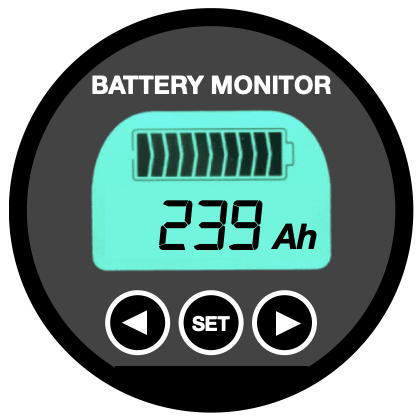 Battery monitor: The voltage output from an AGM battery declines at a linear rate, and reflects the State of Charge (SoC) of the battery. This relationship can be used in conjunction with a voltmeter to provide an estimate of the SoC of an AGM battery. This isn’t practicable with Lithium batteries, as their voltage remains reasonably constant across their discharge period.
-
- We have fitted a new battery monitor – a Coulometer – that calculates the remaining charge in the batteries (measured in Coulombs) by measuring the current moving into and out of the batteries;
- This monitor displays battery voltage, amps in, amps out, remaining Ah, and % charge remaining;
- Net result: This is excellent. We now have a battery monitor that provides far more information than a simple voltmeter. We should have installed one of these monitors years ago! (These monitors will also work with AGM batteries.)
-
- See also: Installing a Battery Monitor >>>
 Discharge period: The battery monitor indicates that the Lithium batteries are discharging around 15Ah between 6:00 pm and 6:00 am, with only the fridge running overnight. (Dometic NRX 115.)
During the following (mostly sunny) days (in Autumn on the NSW South Coast) the batteries are fully re-charged by lunchtime, with electricity generated from the 200W rooftop solar panel (with the fridge still running during the day).
With sunny skies, we could be electrically self-sustained for long periods of time.
-
- The Lithium batteries will power our appliances for much longer than the AGM batteries in a free-camping environment, simply by virtue of their higher usable capacity;
- The total usable battery capacity available from our 2 x 100 Ah AGM batteries was 100 Ah (based on 50% discharge);
- The total usable battery capacity available from our 2 x 120 Ah Lithium batteries is 192 Ah (based on 80% discharge);
- That is nearly double the usable capacity of our 100 Ah AGM batteries;
- Our appliances consume around 40-50 Ah per day. Mainly the fridge;
- In theory, with zero charging, the AGM batteries could power our appliances for around 1.5 days;
- With similar (theoretical) zero charging conditions the Lithium batteries can power the same appliances for 3 days;
- With reasonable solar charging each day during Autumn we are seeing the batteries fully recharged each day, using only the 200W roof-top solar panel;
- In less than perfect solar charging conditions, we can add our 240W solar blanket to the recharging mix, which I expect would allow us to free-camp for far longer than we would be likely to stay in any one location;
- Water supply (and toilet cassette) capacity will now be of much greater concern than electricity supply for free-camping. Carrying more water means more weight – unlike the Lithium batteries that supply double the AGM energy storage capacity for half the weight!
- Net result: Electric energy storage is no longer an issue. The voltmeter remains around 13.3 volts for days on end. There is no longer the need to check battery voltage every few hours. The energy storage in Lithium batteries, recharged by the solar panel, will last much longer than we are likely to be free-camping without starting the engine. Next we will need to figure out the provision of a renewable water supply!
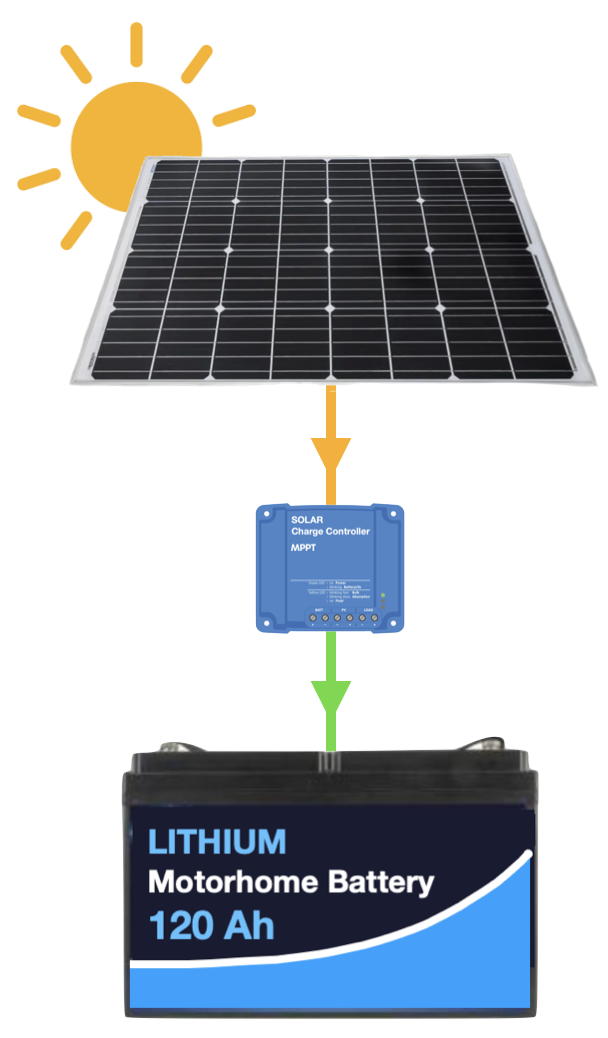 Re-charging: In theory, (and that is a big ‘in theory’) Lithium batteries are able to re-charge much more quickly than AGM batteries. Lithium batteries can charge continuously at a rate (amps) of up to 50% of their rated capacity (Ah) while AGM batteries are limited to a re-charge current of up to 20% of their capacity.
-
- Lithium batteries achieving significantly faster charging depends on a relatively high rate of charging current. A bit of a moot point if your solar panels are producing only a small amount of current that doesn’t take advantage of the potential higher recharge current capacity;
- The reality is that with only 10 amps input from our 200W solar panel (in good weather), 2 to 3 amps of which is consumed by the fridge, there will be very little noticeable reduction in the re-charge time of the Lithium batteries compared to AGM batteries when charging from the solar panel;
- With higher current input from the vehicle alternator or the 230V charger, the Lithium batteries are likely to recharge more quickly than AGM batteries when these sources are generating current;
- The battery monitor indicates that, when plugged in to power, the CTEK M25 AC-DC charger is feeding 25 amps into the batteries. When the engine is running, the vehicle alternator is pushing 40 amps into our energy storage, even when idling. The alternator charge rate is governed by the Redarc 1240D charger.
- Net result: Without any re-charging, the 2 x 120Ah Lithium batteries will power our appliances for nearly twice as long as the 2 x 100Ah AGM batteries. Electrical current generated by the solar panel/s will considerably extend this period of time when we are off the grid. Both the solar panels and the vehicle’s alternator appear to re-charge the Lithium batteries a little more quickly than the AGM batteries, but I am not able to easily verify that assessment.
 Appliance options: The Lithium batteries have given us the opportunity to install an inverter, to power 230V AC appliances from the 12V DC batteries. We can now pull up for lunch at a beach carpark or roadside rest area and pop a couple of toasties in the sandwich press.
-
- Lithium batteries are able to supply a high level of continuous current, compared to AGM batteries;
- The Sphere Lithium batteries can supply a continuous 100 amps each. This provides around 180 – 200 amps with the two batteries connected in parallel;
- A couple of toasties in the sandwich press for lunch pulls current at the rate of around 97 amps, draining 5Ah from the batteries’ storage;
- 10 mins of driving recharges the current used for the toasties!
- Net Result: Appliances such as a toaster, sandwich press, coffee machine, hair dryer – even the microwave oven and induction cooktop – are now able to be used when mains power is not available. This certainly takes us to the next level of glamping!
 Voltage: After testing the Lithium batteries for five consecutive days and nights, with the fridge running with no charging other than the 200W solar panel, the voltage hasn’t dropped below 13.2V.
-
- AGM batteries drop from 12.8 to 12.1 volts over their 50% discharge period.
- Lithium batteries drop from 13.5 to 12.9 volts over their 80% discharge period.
- After running the fridge all night for consecutive nights, the Lithium batteries are still maintaining 13.2V first thing in the morning, compared to around 12.3 V for the AGM batteries.
- Net result: Our fridge is likely to maintain a more reliable temperature over a longer period of time, and will use slightly less current when operating at a higher voltage.
 Life cycle: The label on the new Lithium batteries indicates that they have a minimum 2000 charge cycles – which will last us forever! Well, maybe not forever, but longer than the AGM batteries.
-
- AGM batteries are able to be discharged / recharged around 500 times over their life span, if not discharged to below 50% capacity.
- Lithium batteries have at least 2000 recharge cycles if not discharged below 20% capacity. (Up around 6000 cycles if discharged to only 50%.)
- Net result: Hopefully the new batteries will maintain their performance for 10 or more years, so I will feel better about the high up-front cost. However, I am not so naive to think that there won’t be something bigger and better available by then!
See also: Lithium Battery Upgrade | Installing a Battery Monitor | Installing an Inverter
|
More reading:
|
Batteries | Consumption | Battery Recharging | Solar Charging | How Long Without Sun? | Alternate Charging Options | Solar Regulators | The Bottom Line