See also: Battery Recharging | Solar Charging | Portable Fridge & 12V Power | 12V Basics
More solar stuff: Solar Regulators | Solar Charging – The Nitty Gritty
We recently upgraded our solar panels and compressor fridge to new models. Below is our hands-on experience with solar recharging of the batteries in our Campervan….
| December 2025 Update | ||
|
We have replaced our original solar panels and fridge with new equipment….
These upgrades were initially prompted by an electrical failure of the rooftop solar panel (which has since been replaced for no cost by Redarc) and the declining performance of the Dometic fridge. The new gear has made a significant improvement to our off-grid sustainability capacity. The new solar panels produce more electricity than the old panels, while the new fridge consumes less electricity than the old fridge. We are now generating more electricity each day than we consume – at least in sunny weather. The information below will be more fully updated when we have tested the new fridge and solar panels over an extended period of time. |
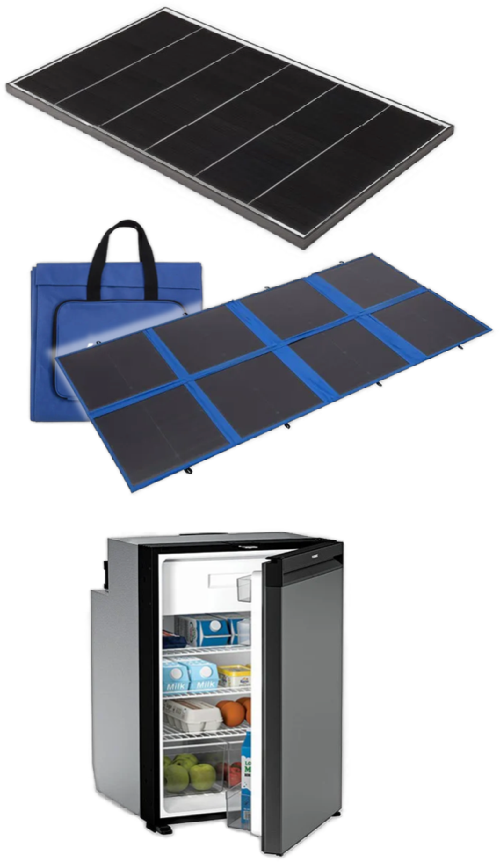 We replaced our 150W Redarc rooftop solar panel with a Redarc 200W panel
Our (new) setup
-
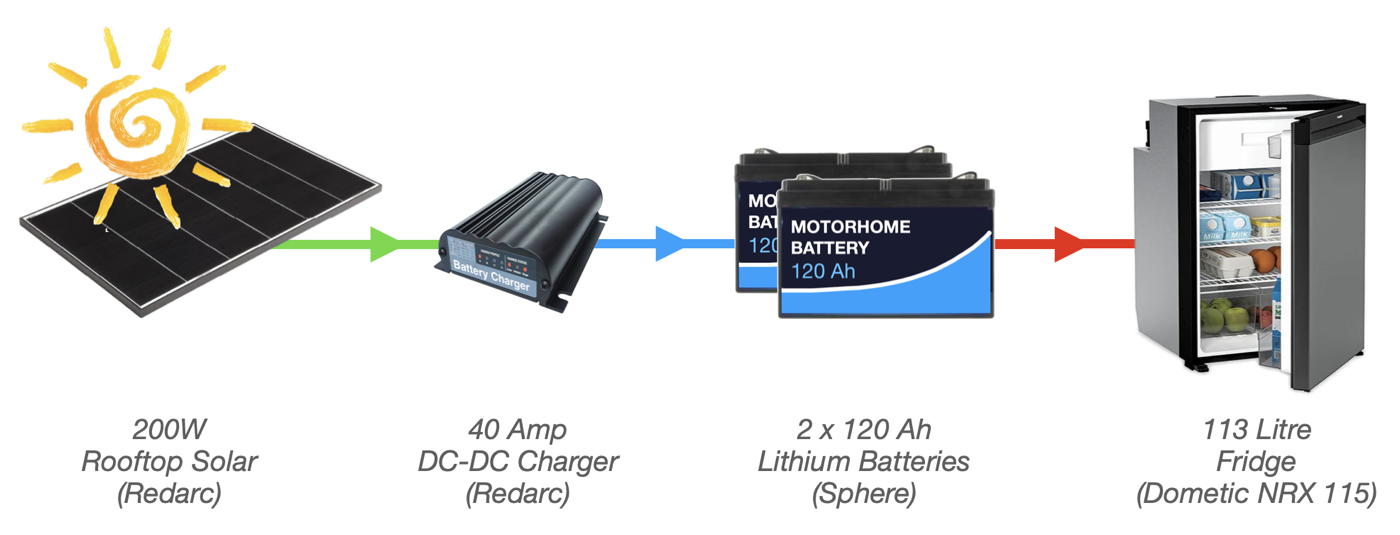
- Permanent Solar: 200W panel on the roof (Redarc);
- Portable Solar: 240W folding blanket (Kings);
- Batteries: 2 x 120 Ah Lithium (Sphere);
- Battery charger: BCDC 1240D (Redarc);
- Fridge: 113L upright fridge / freezer (Dometic NRX 115)
Energy Consumption
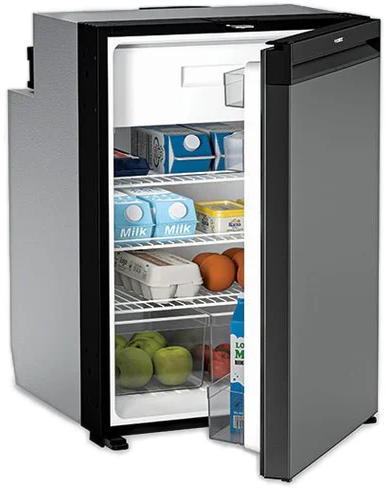 Our fridge is the largest consumer of our batteries’ stored electrical energy over 24 hours. The upright fridge draws just over 3 amps when the compressor is running – though this doesn’t appear to be too often. Set on ‘Eco’ mode the fridge consumes only around 12 – 18 Ah of stored battery energy over 12 hours (6pm – 6am), or 1 – 1.5 Ah of stored battery energy each hour.
Ditto for daylight hours (6am – 6pm). This adds up to 24 – 36 Ah of depleted stored battery energy every 24 hours.
For all the measurement and monitoring listed on this page we have used the fridge as the only device consuming electrical energy from the battery. With the combination of the upgraded fridge and solar panel offering an energy surplus we can now make more off-grid use of appliances such as the microwave oven, sandwich press and induction cooktop – all of which were mostly reserved for use when we were connected to mains power.
Our electrical system includes a 2000W inverter (iTechWorld). We use this for running a microwave oven, sandwich press, and a hair dryer when required. We also have a portable induction cooktop, but most cooking uses LPG appliances.
Recharging Options
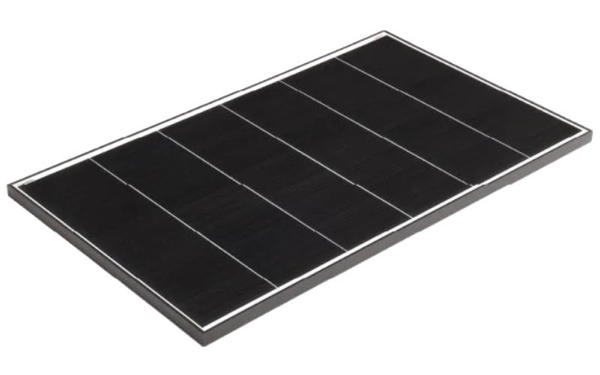 Our van has a single 200W solar panel mounted on the roof. In the middle of the day (in summer) the panel produces 12 amps of electrical energy, theoretically returning 12 Ah of stored energy to the batteries per hour in the middle of the day.
On a sunny summer day the 200W solar panel restores around 60 Ah of electrical energy over a 12 hour period (6am – 6pm).
Our other charging sources include the vehicle alternator, a 230V mains charger, and a portable 240W solar blanket.
The 240W solar blanket (Kings) generates a maximum 10 amps in the middle of the day, returning around 10 Ah per hour to the batteries, while the sun is shining.
The Energy Balancing Act
Our fridge consumes around 1 – 1.5Ah of stored energy per hour, every hour of the day. whether the sun is shining or not. (Our old fridge was soaking up 2.5 – 3 Ah every hour.) The 24 hour energy consumption of the fridge is around 30 Ah. (Maybe a bit more in hot weather but we will work with 30 Ah as a neat round figure.)
In the middle of the day the 200W solar panel is generating 10 Ah per hour (up to 13 amps in the middle of the day in summer) – less in the morning and afternoon. Our monitoring indicates that between 6am and 6pm (in summer) the solar panel can return around 60 Ah of electrical energy to the batteries, though this has been difficult to measure since installing the new fridge because the battery charge rarely drops low enough to require that much of a recharge!
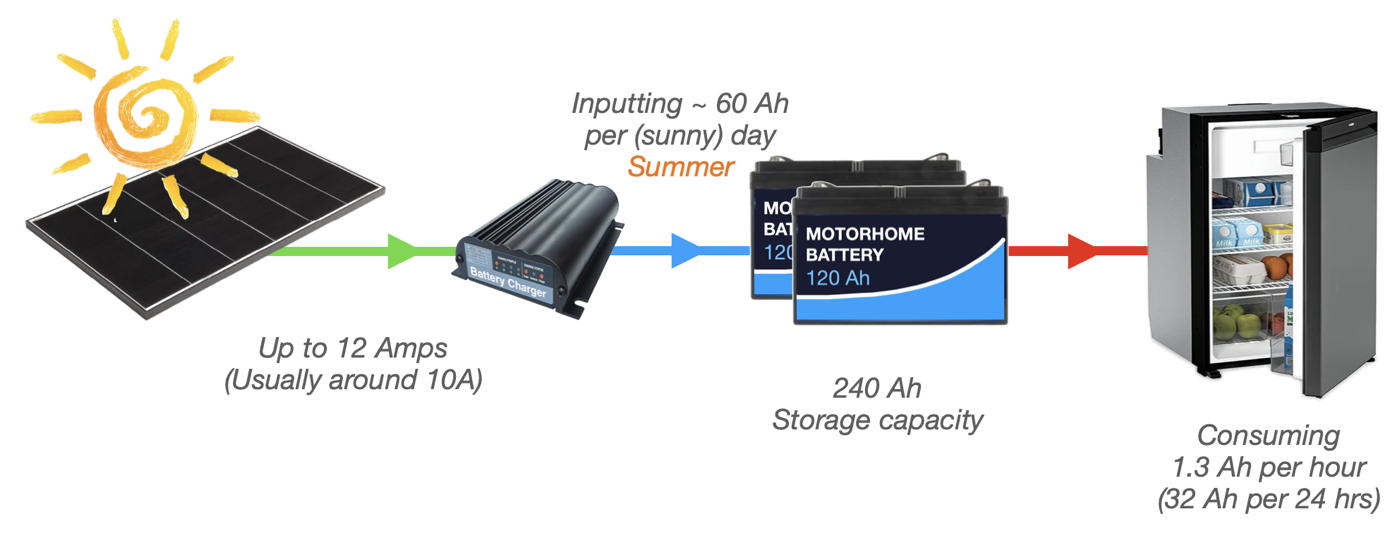
That’s a 24 hour net excess of around 30Ah of generated electrical energy.
Off-grid longevity
 Our 2 x 120 Ah Lithium batteries have a usable capacity of 192 Ah (80% of label capacity). (Some Lithium battery suppliers claim 100% usable capacity – though we prefer to play it safe with 80%).
So, with a daily energy excess of 30 Ah (with the fridge being our main energy consumer) we could free-camp indefinitely – while the sun is shining.
Early days, but our experience so far with the new fridge and solar panel is that the battery is fully recharged by 10:00 am each day – in summer, with a clear sky. We have also confirmed that parking the van on a slight incline, with the solar panel tilting a few degrees towards the south (away from the trajectory of the Sun here in Australia), considerably reduces the output of the panel. Panel alignment to the sun is important.
| No Sun, No Worries | ||
|
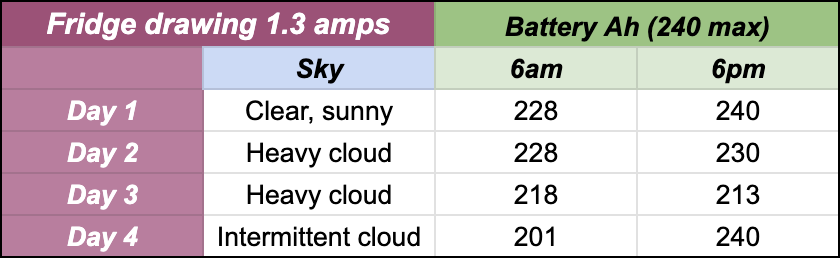
All is not lost on cloudy days – so long as you have enough battery capacity to get you through to the next sunny day. Over a couple of very cloudy days, with a little light rain, in December (Summer here in Australia), the 200W rooftop solar panel was still supplying a very small amount of electricity to the batteries during the day.
After the second day of consecutive cloudy days, the batteries’ stored energy reduced from 218 Ah at 6am to 213 Ah at 6pm – a net loss over the day of just 5 Ah, even with the fridge running for 12 hours, consuming 1.3 Ah of stored electrical energy each hour. Which runs out at about 15 Ah of battery drain. That would suggest that the solar panel still returned 10 Ah to the batteries over the day, despite the heavy cloud. After the following day of (mostly) clear skies, – with a little light cloud – the batteries were back to full capacity. |
Charging alternatives
As noted above, in good summer weather no charging sources other than the rooftop panel are required to keep our batteries charged, if we are only running the fridge and other low consumption devices such as lights and TV. Or charging phones and iPads.
For use in less than optimal weather, or if we are using other appliances that may consume larger amounts of stored electrical energy, such as the microwave oven and sandwich press, we carry a fold-up 240W solar blanket. This blanket can produce up to 10 amps of electrical current, theoretically recharging 10Ah of capacity to the batteries each hour. Though if the batteries are close to fully charged this input will be tapered by the charger to suit the batteries’ requirements.
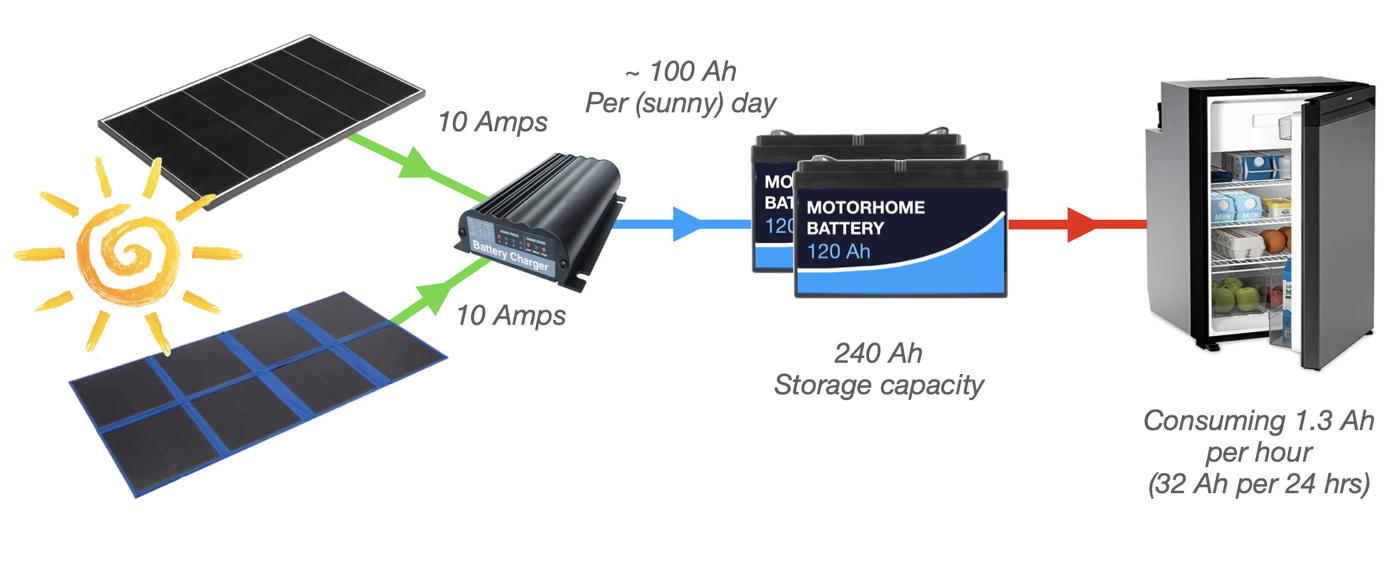
We can also use the portable blanket if we are camped under trees. A 10 metre cable connects the solar blanket from a sunny location back to our van parked in the shade.
There are two Anderson plugs fitted on the outside of the van – one connected to the Redarc BCDC charger, in parallel to the rooftop panel connection, the other connected directly to the Lithium batteries.
The direct-connect plug also forms part of our backup plan, in case the main DC-DC charger or the rooftop solar panel fails, we can connect our portable solar blanket and a portable solar controller to re-charge the batteries directly.
Expert advice suggests that with two solar panels connected to the Redarc charger, the input from the larger panel may be reduced to the output from the smaller panel. Which isn’t too much of problem for us, because both panels are have roughly the same output. But if it becomes an issue we can connect the solar blanket via the portable solar controller directly to the batteries, as discussed above.
Either way, in sunny weather we will be generating more electrical energy than we are consuming.
With cloudy skies, and minimal charging from the solar panel/s, battery capacity becomes a more critical factor.
Of course, we also have DC charging available from the alternator, and 230V AC charging available when connected to a mains supply.
Seasonal fluctuations
 The figures below are for comparison, using only the 113L fridge as a discharging load (1.3 Ah per hour) and the 200W roof-top solar panel as a charging source. (More info here when we have used the new equipment over a 12 month period.)
-
- Summer: Daily excess = 30 Ah
- Autumn: Daily excess/deficit = TBA
- Winter: Daily excess/deficit = TBA
- Spring: Daily excess/deficit = TBA
The Nitty Gritty
 What gear do you need to keep the fridge cold when camping off the grid (in sunny weather)?
Based on our experience with our particular battery/fridge/solar setup, here are some guesstimates of battery capacity required for various travel options…
-
- Weekends: a 120 Ah Lithium battery and (maybe) a portable solar panel or blanket;
- A week: a 120 Ah Lithium battery and a 200W portable solar panel/blanket;
- A couple of weeks: 240 Ah of Lithium battery capacity, and a good quality 200W solar panel. In sunny weather, and with use of only the fridge and phone charging, etc, probably indefinite;
- More than 4 weeks: with regular use of inverter-powered glamping appliances: 400 Ah of Lithium battery capacity and 600W of solar panel capacity. (Though much less than this if your appliance needs are more modest. 240 – 300 Ah of Lithium battery capacity and 200W of solar will generally be fine.)
All the above examples assume sunny skies to generate electrical energy from a solar panel. Be prepared with additional battery capacity or alternate charging options if the sun isn’t shining. Also consider that the use of an inverter to run 230V appliances will chew through your stored energy very quickly, or that a chest style fridge / freezer will use less energy than the upright model discussed here.
Keep in mind too that the other important consumable for off-grid camping is water. You will likely exhaust your water supply before your electricity supply.
See also: Battery Recharging | Solar Charging | Portable Fridge & 12V Power Options