Sustainability: Batteries & Solar | Water | Heating
Batteries | Consumption | Battery Recharging | Solar Charging | How Long Without Sun? | Alternate Charging Options | The Bottom Line
More solar stuff: Solar Regulators | Solar Charging – The Nitty Gritty
| Our Setup: The quick overview… | ||
|
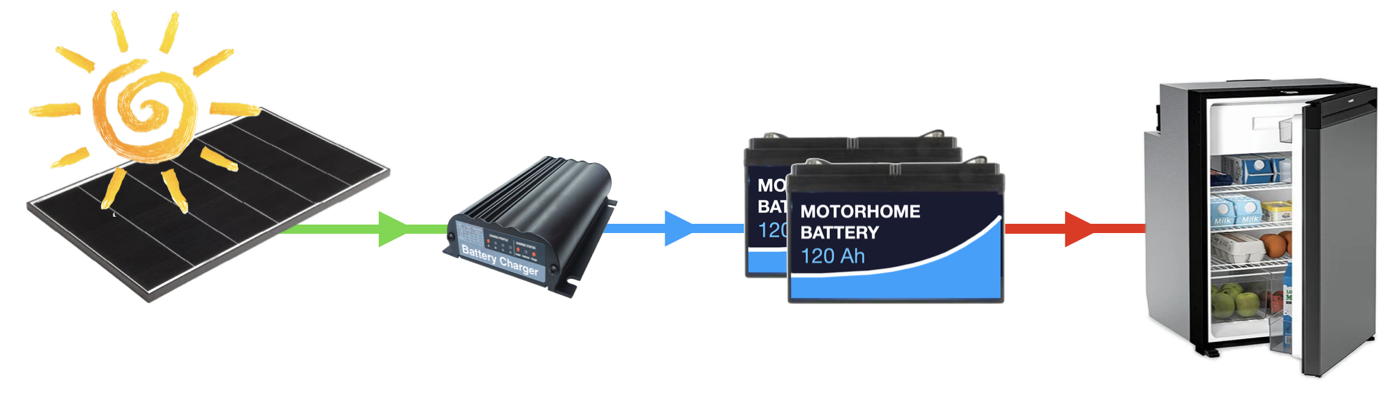
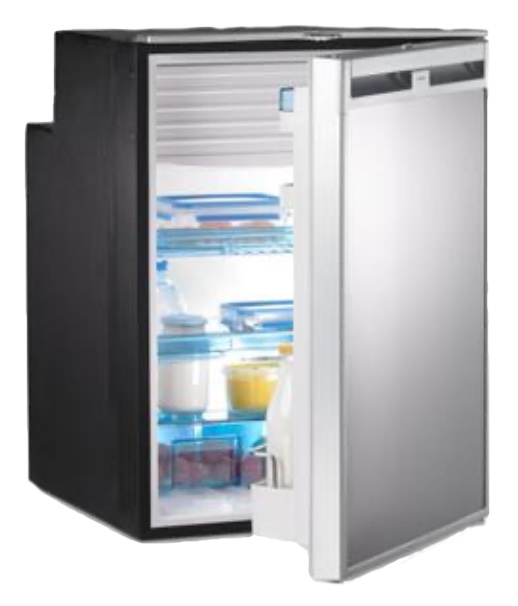
We have a 200W rooftop solar panel (Redarc) which restores from 30 Ah to 60 Ah of electricity each day to our 2 x 120 Ah Lithium batteries (Sphere). Our largest consumer of our batteries’ stored energy is a 113L fridge (Dometic NRX 115) that consumes around 25 – 35 Ah of stored energy each 24 hrs. We also carry a 240W portable solar blanket (Kings) which can recharge up to 60 Ah of electrical energy to the batteries each day, but is used only as a supplementary panel for use in cloudy weather, or if we are parked in the shade of trees. Most days we are generating more electrical energy than we are consuming – so long as the sun is shining! |
||
|
Energy consumption
Solar generation
The bottom line
See also: Solar Charging – The Nitty Gritty >>> |

Solar energy to 12V electricty
Solar panels are a great example of a modern technology that (in partnership with advances in other gear such as batteries and LED lights) has forever changed the camping appliance landscape. Every campsite is now able to host a plethora of electrical appliances and gadgets, powered by renewable energy being generated from the Sun by solar panels.
And let’s not forget that modern solar panels only convert around 20% of the solar energy that falls on them into electrical energy. Things will only get better as the technology improves.
What is a solar panel?
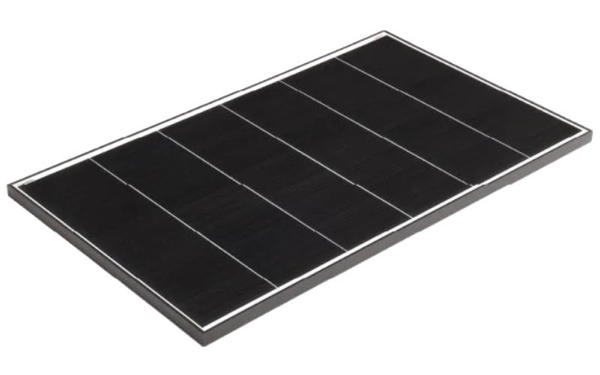 Solar panels are made up of a number of photovoltaic (PV) cells connected together and encased in sheets of glass or plastic.
The photovoltaic effect of the element Selenium (a non-metal semi conductor) was discovered in the 1800’s. Knowledge of the properties of these chemical elements lead to the development of the early solar panels used to power orbiting satellites in the 1950’s. The modern era of silicone solar panel development took off with the energy crisis of the 1970’s, when the need for alternative energy sources became a more urgent reality.
Modern solar panels are made up of a number of cells connected together. (Much like the cells in a battery.) Each cell is composed of two layers of silicon, each coated with other materials (typically boron and phosphorus) to create positive (+ve) and negative (-ve) layers. When photons in sunlight land on the cells they cause electrons to flow from the negative to positive layers, creating an electric current. This current is collected by copper wires that are connected to the network of cells within the solar panel, terminating outside the panel with a positive and negative cable, which are then usually connected to an Anderson plug.
So, how do the electrical systems in our Campervans use this electrical current from the solar panels to recharge our batteries? And how ‘sustainable’ is our 12V electrical system when free-camping – in our case, 2 x 120 Ah Lithium batteries being recharged with electrical current from a 200W solar panel on the roof? Read on…
See also:
-
- Are all solar panels the same? (Kings, YouTube) >>>
- Redarc vs Kings Solar Blanket shootout (Musing Greg, Youtube) >>>
- 12V Charger cabling – Get it right >>>
Getting connected
 A solar panel produces electrical current. We feed this current to the batteries, to ‘recharge’ the stored energy in the batteries – ie, pushing electrons from the +ve battery terminal back to the -ve battery terminal. But this MUST be done via a battery charger/controller/regulator – solar panels cannot be connected directly to the battery.
The output voltage of camping solar panels is around 18V – 23V. The maximum voltage for charging a deep-cycle battery is around 14.6V. Connecting 20V straight to the battery would damage the battery.
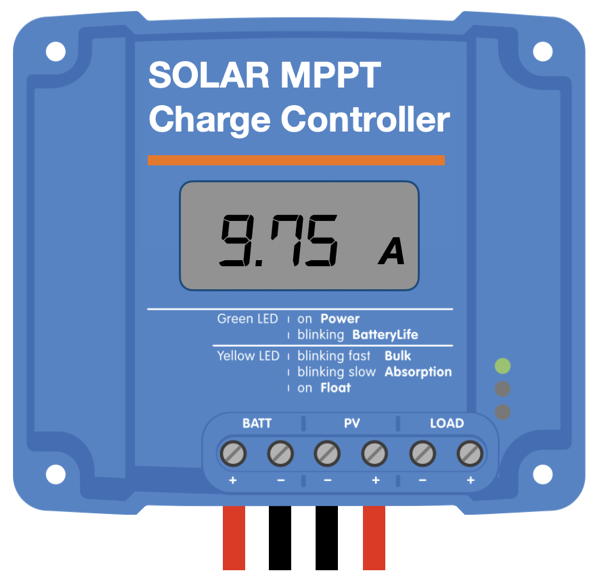
A solar charge controller (aka a solar regulator) connected between a solar panel and the battery regulates the voltage from the solar panel, and controls how much current flows from the solar panel to the battery. The controller also monitors the State of Charge (SoC) of the battery, regulating and adjusting its output current to suit the charging requirements of the battery as it approaches its fully charged capacity. Among other things, this prevents the battery from overcharging and overheating. It also ensures optimum charging levels and battery longevity.
Check that your solar controller is suitable for the battery to which it is connected. The voltage, current and charging profile of AGM batteries is different to the requirements of Lithium batteries. Most modern, good quality solar controllers are able to be switched to suit different batteries.
Some more expensive solar controllers include bluetooth connectivity which provides monitoring and configuration using an app on a mobile phone. Other portable solar controllers include a digital screen, which can display voltage and current throughput.
-
- See also: Recharging Campervan Batteries >>>
Which Controller?
There are two common types of solar charger….
-
- PWM (Pulse Width Modulation) chargers are the original solar controller technology, and are cheaper than their MPPT cousins.
- MPPT (Maximum Power Point Tracking) chargers are based on more recent technology than PWM chargers. This is the charger to buy. They are a little more expensive than PWM chargers, but are generally more efficient, and feed more current from the solar panel to the battery, especially in low light conditions early in the morning and late in the afternoon. (Check that your controller can be set to charge both Lithium and AGM batteries.)
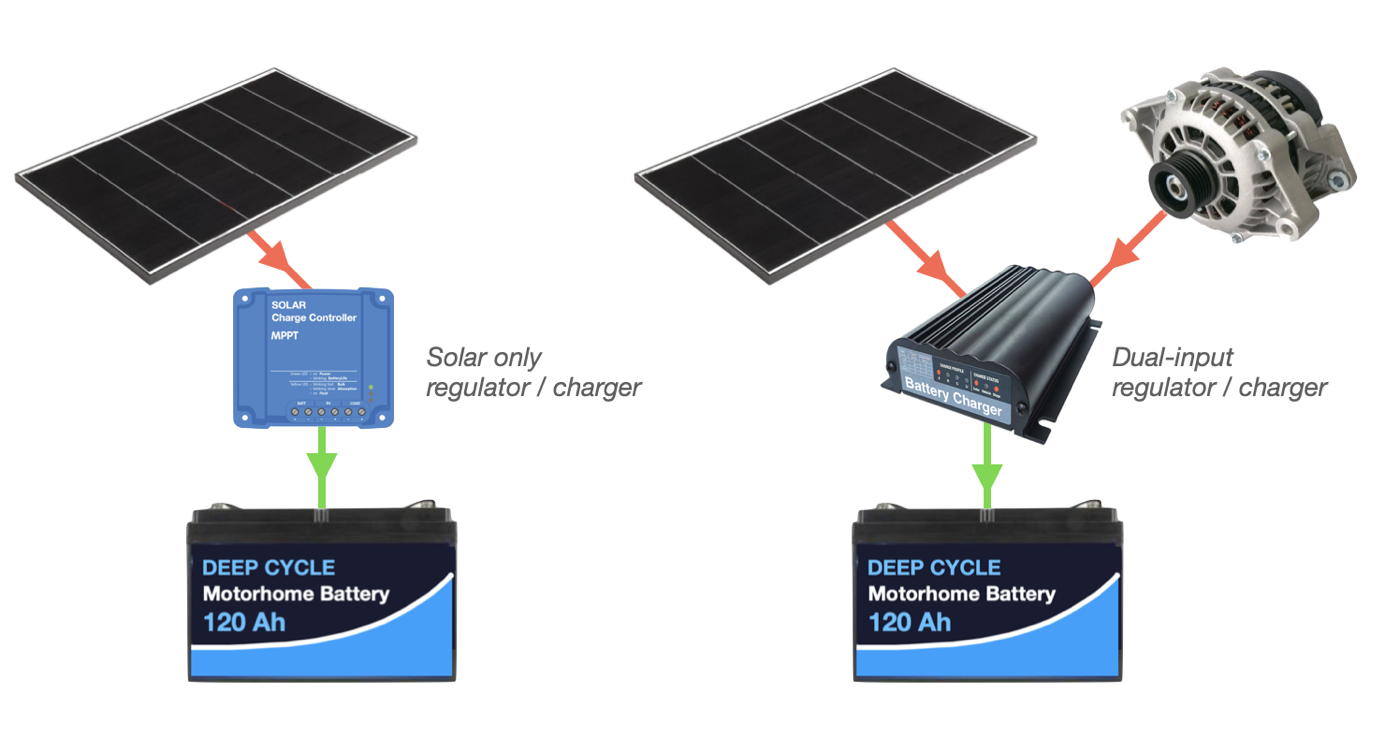
Dual input DC-DC chargers accept input from both solar panel/s and the vehicle alternator. These chargers are popular in Campervans and Motorhomes, avoiding the need to install separate chargers for the solar panel and the alternator. The solar input circuitry of these more modern chargers is usually based on MPPT technology.
More info: Solar regulators >>>
Portable Panels?
If you have a portable solar panel as your main solar charging source, or you use a portable panel to complement your roof-top panel, it must also be connected to the battery through a suitable regulator. This can be a separate independent unit in-line with a cable directly to the battery, or it can be connected to the same charger/regulator as a roof-top solar panel, depending on the input capacity of the charger.
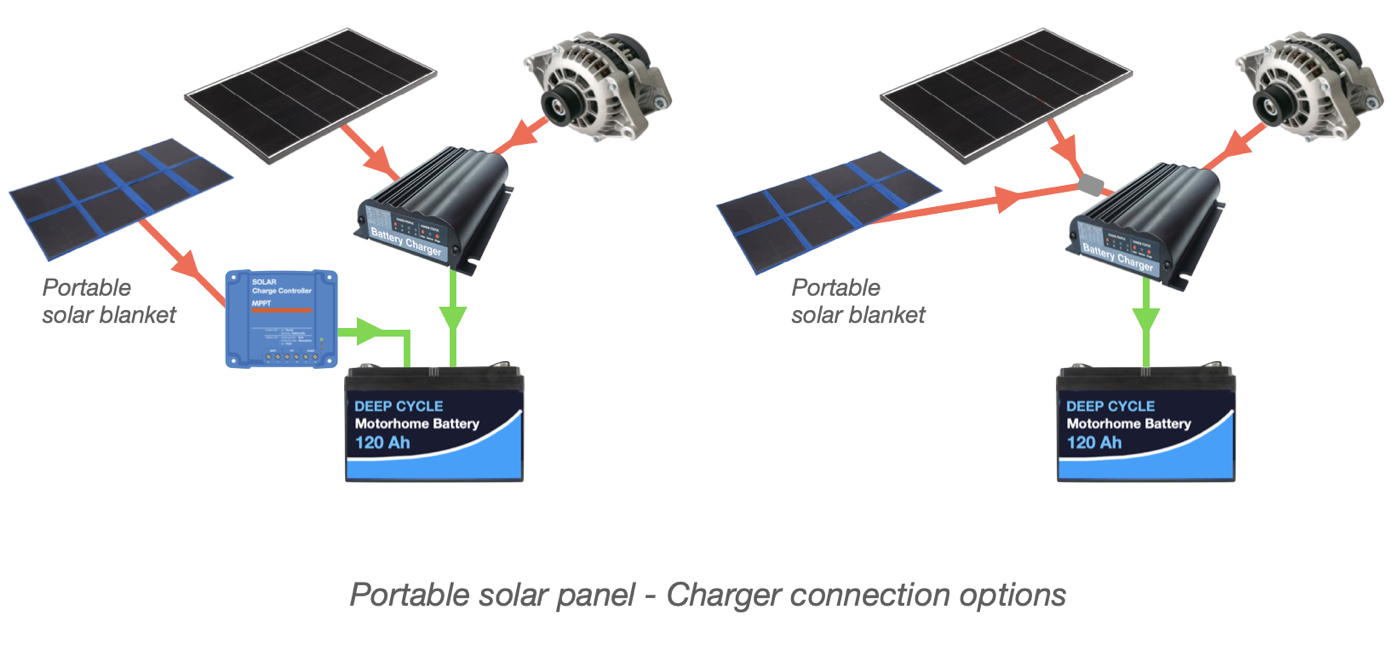
| Multi-panel connections | ||
|
These cables are available from Anaconda, BCF, Jaycar, etc. No need for super heavy cables for this connection. Check that the combined current output (Amps) from the two panels does not exceed the maximum input rating of the charger. Also check that the voltage output of each panel is about the same (VOC – Voltage Open Circuit), or the output will be ‘throttled’ to the voltage of the panel with the lesser voltage. If necessary, to circumvent any issues, you can connect your second panel to the battery through an independent portable controller. |
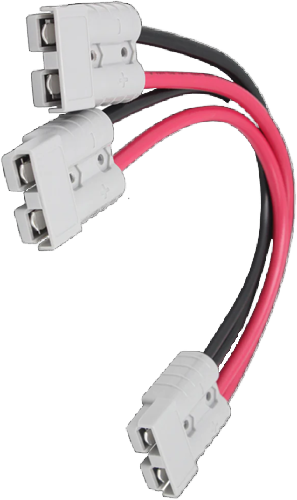 If you are connecting two solar panels to your DC-DC charger – for example, a fixed roof panel and a portable panel – the two panels can be connected in parallel using an Anderson ‘Y’ connector as shown on the right. (Also known as a piggy-back connector.) This connector is then connected to the solar controller.
More infö: Solar regulators – MPPT and PWM >>>
Battery charging profile
It is important that your battery charger is set to the ‘charging profile’ required for your battery type – AGM (lead-acid) or Lithium (LiFePO4)…..
AGM batteries are charged in three stages….
-
- Boost / Bulk – steady current input – up to 25 amps constant charge rate, until the battery is at 70% storage capacity;
- Absorption – reduced current rate until the battery reaches 100% storage capacity;
- Float – trickle charge to maintain the battery at 100% storage capacity.
Lithium batteries are charged in two stages…..
-
- Boost / Bulk – steady current input – up to 50 amps constant charge rate, until the battery reaches 90% storage capacity;
- Absorption – reduced current rate until the battery reaches 100% storage capacity;
- Lithium batteries are able to charge with higher current than AGM batteries, which can result in faster charging – if you have enough input current available. (5 or 10 amps from a solar panel won’t make too much difference!)
Monitoring charging status
It is worth becoming familiar with the information provided by your battery charger, so that you can understand the charging status of your system.
Better quality single-input portable solar regulators may have a digital display, but many others will most likely have a series of LEDs indicating the level of charge, as a percentage of full charge.
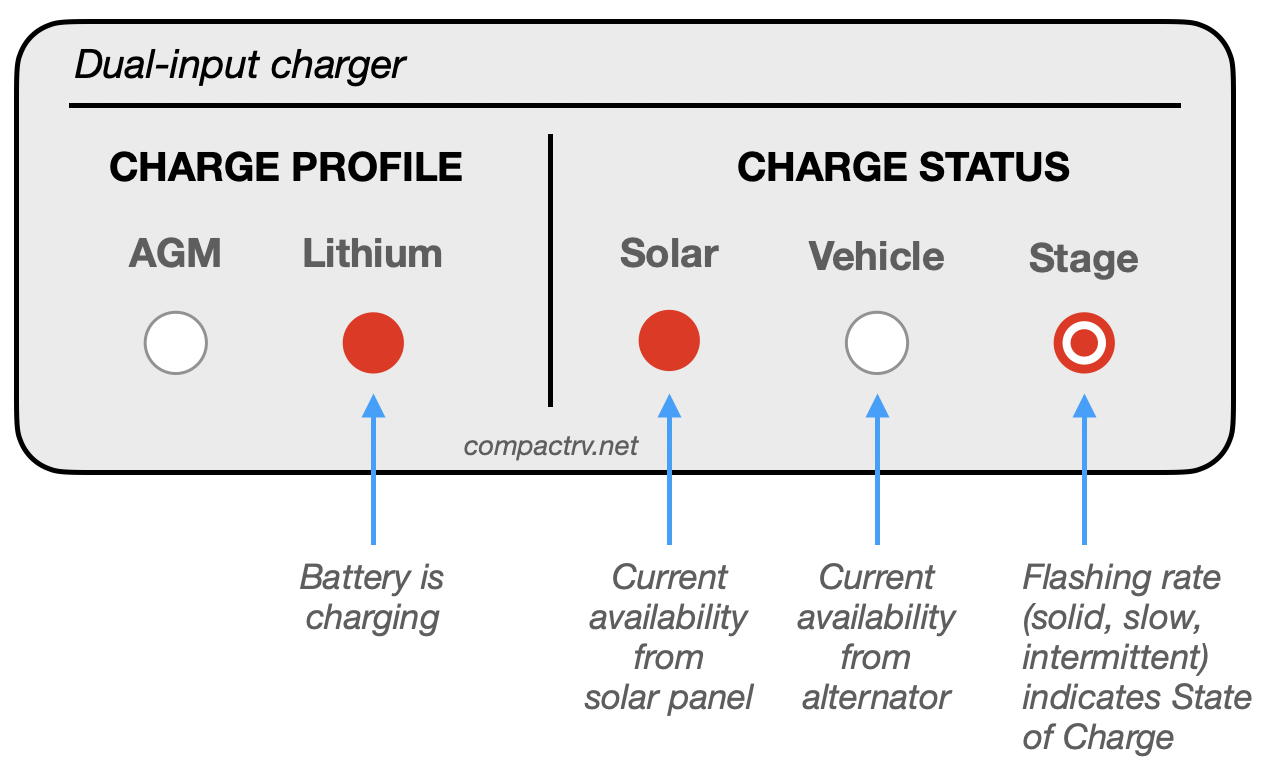
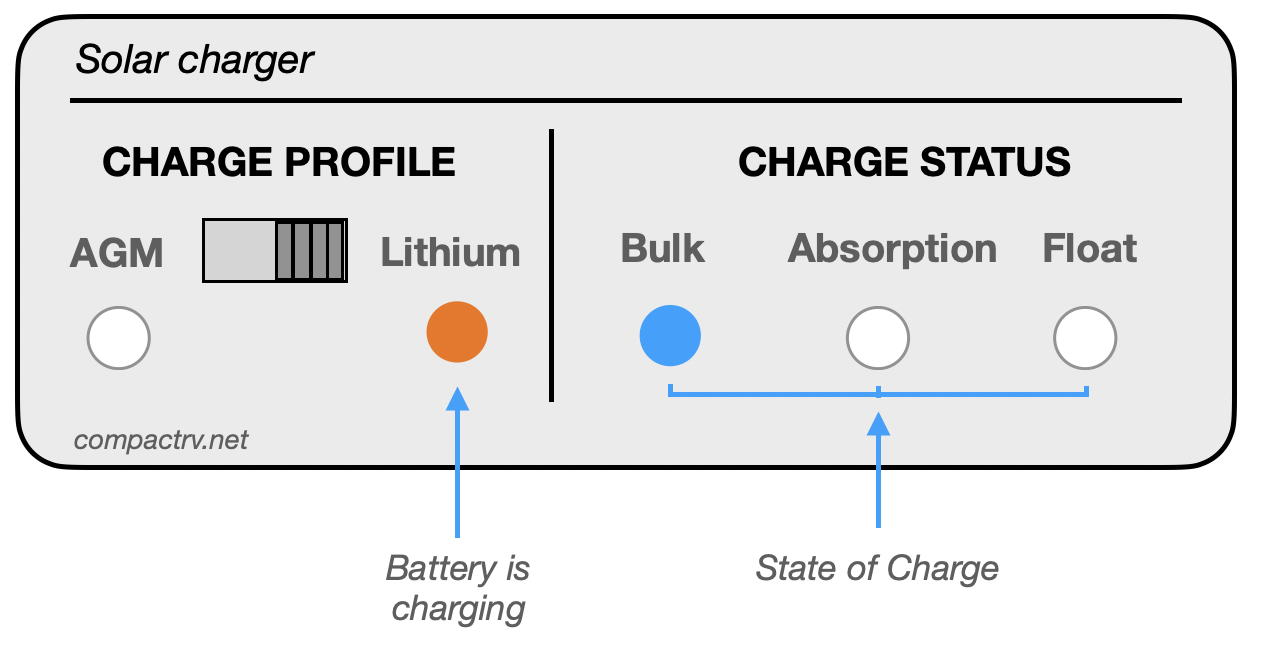 An LED display on a dual-input battery charger (eg Redarc chargers) may look something like that shown in the image below when charging from the solar panel:
Voltage, Current & Power
If your solar controller doesn’t have a display, the voltage and current output from a solar panel can be accurately measured with an inline power meter.
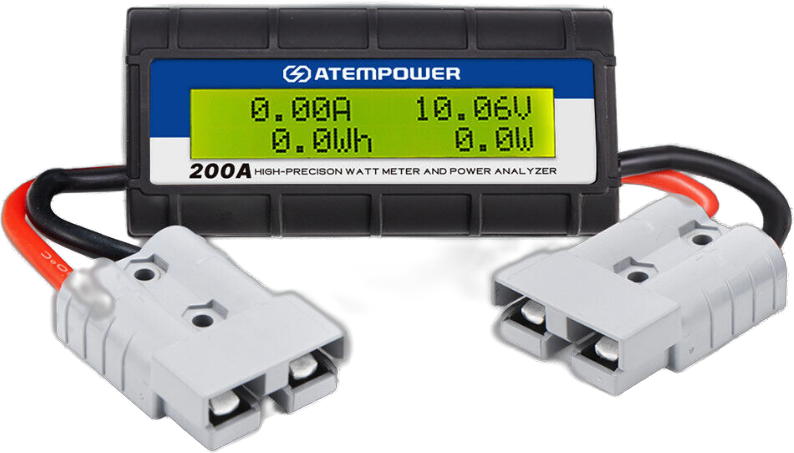
These meters are particularly useful for measuring input from portable solar panels and blankets equipped with Anderson Plug connectors. These meters are widely available through online stores or specialist camping retailers for around $20. (Check your local BCF store for an XTM Watt Meter )
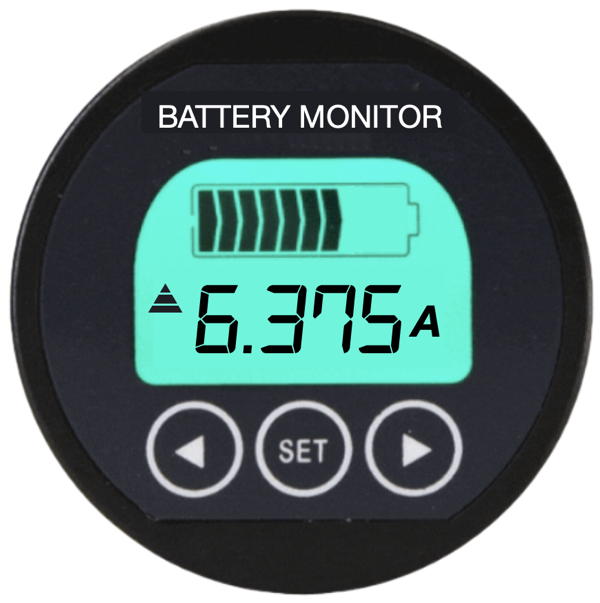
Your van’s built-in battery monitor can also be used to measure the current charging the battery/s from a solar panel, so long as the solar controller / regulator is connected to the battery/s via the monitor shunt. (Keep in mind that this is a display of the ‘net’ current in / out, so other devices should be powered off, or taken into consideration when calculating solar panel input.)
Monitoring battery charge status
AGM batteries: A voltmeter can be used to estimate the charge status of an AGM battery. The voltage of AGM batteries has a fairly direct and linear relationship with the battery’s State of Charge (SoC).
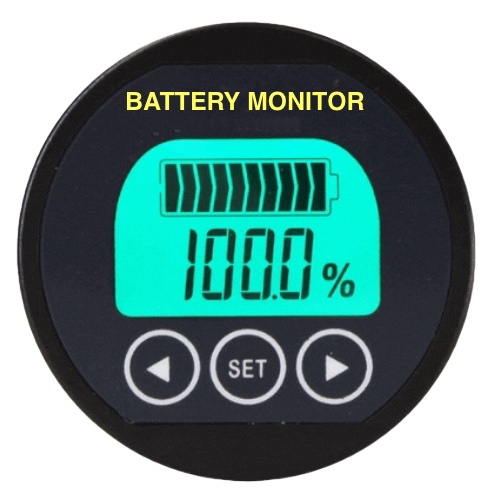 Lithium batteries: Lithium batteries maintain a reasonably constant voltage over their discharge period, so a voltmeter will not provide enough information to indicate the SoC of a Lithium battery (until it needs recharging). A meter known as a Coulometer (measuring Coulombs) estimates the State of Charge of Lithium batteries by measuring the current input and output from the battery.
More info about battery charging and charging profiles:
Recharging capacity
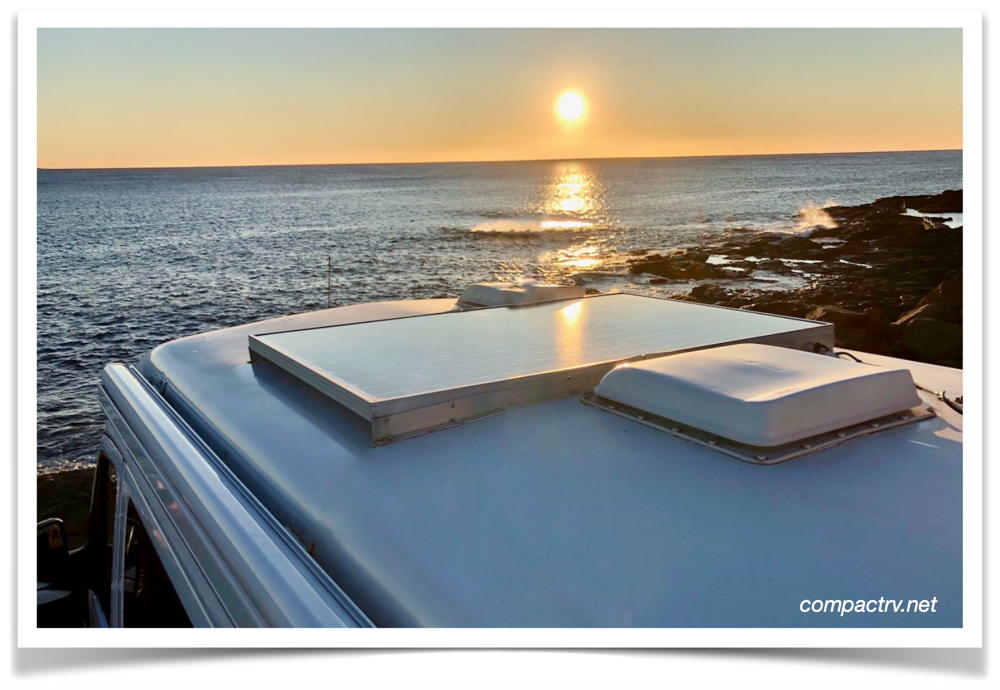 For the purpose of this exercise, let’s consider that our 200W roof-top solar panel is our only source of energy for battery recharging.
Our Lithium batteries have a combined storage capacity of 240 Ah, which results in a usable capacity of 192 Ah. (Lithium batteries shouldn’t be discharged below 20% capacity.)
To make things that little bit more confusing, the electrical output of solar panels (and the electrical consumption of other devices) is usually specified with a Power rating, measured in Watts (W), while battery consumption and capacity is specified in Current, measured in Amps and Amp Hours.
So, how much electrical Current (Amps) is the 200 Watt solar panel returning to the batteries?
If you were paying close attention in those science lessons at school (!) you may recall the relationship between power, voltage and current (P=VI)….
-
- Watts / Volts = Amps
Our Redarc rooftop solar panel has a Power rating of 200 Watts. We also know (from manufacturer information) that solar panels produce electrical energy at around 20 Volts.
So, using the Watts / Volts = Amps formula we can calculate the theoretical current produced by the solar panel (in Amps) that is available for recharging the 240 Ah batteries:
-
- 200W / 20V = 10 Amps.
Experience suggests that in real-world conditions this is more likely to be closer to 8 Amps – or 12 amps in good summer conditions. (A good quality MPPT solar controller can boost the current reaching the battery from the panel.)
If we get an average of 6 hours of ‘usable’ sunshine (Autumn/Spring, 9am to 3pm), this will restore around 40 Ah each day to the batteries. In Summer our 200W panel returns around 60 Ah to the batteries.
How long is your piece of string?
Keep in mind that there are huge variables in these considerations….
-
 More sunshine is available on longer summer days;
- Less sunshine is available on shorter winter days;
- Photovoltaic sunlight exposure increases during the middle of the day;
- The angle of the solar panel to the sun affects the current produced – horizontal on the roof isn’t ideal;
- In summer, overheating of the solar panel reduces current output;
- In summer there is likely to be more current drawn by the fridge;
- The ‘Winter’ setting on a fridge can increase power consumption;
- Frequently opening the fridge door results in increased energy consumption;
- A fridge full of cold food consumes less energy than an empty fridge;
- Other optional appliances, such as fans, heaters, etc, also draw current;
- Many appliances consume current when in ‘standby’ mode;
- 230V appliances powered through an inverter – hair dryers, coffee percolators, toasters, etc – use large amounts of power;
- A good quality MPPT regulator can feed more current (than a PWM regulator) from the solar panel to the batteries in low light;
- etc, etc.
- How long is your piece of string?
Generally speaking though, our experience suggests that (on average, in south eastern Australia, in Autumn and Spring), a single 200W solar panel has the capacity to (on average) to replenish our daily depleted battery capacity, from one day to the next – if the sun is shining!
In the previous section we calculated that (after upgrading to a new fridge) we are consuming around 50 Ah of our batteries’ stored energy supply per day, of the 192 Ah available. Our Redarc 200W solar panel is generating at least that much electricity on a sunny day. Based on theoretical ‘average’ (autumn/spring) figures, we can easily camp for a couple of weeks supported only by stored battery energy recharged from the 200W roof-top solar panel.
But that is in theory. What about in real life?…..
 When we first purchased our van (in November – leading into the Australian summer) we parked the van in our driveway and powered up the fridge to test the solar panel’s 12V recharging capacity. In those days we had 2 x 100 Ah AGM batteries installed.
-
-
- The fridge contained only a bottle of water;
- The fridge was powered only by the AGM batteries;
- The batteries were brand new;
- The only battery charging input was from the 150W solar panel on the roof;
- I checked the battery meter most mornings before sunrise and it was never below 12.3V.
- Each afternoon the Redarc charging regulator was indicating that it had switched to a ‘Float’ charging, or trickle-charge rate, indicating that the batteries were close to fully recharged;
- The van ran like this for a couple of weeks, with the fridge running and powered only by the batteries.
-
This was in late spring / early summer, and it was sunny each day, although we weren’t actually ‘using’ the fridge, or running any other appliances. It appeared that the solar panel was fully recharging the batteries each day.
The Lithium option
We replaced our 2 x 100 Ah AGM batteries with 2 x 120 Ah Lithium batteries. This has effectively doubled our storage capacity – from the 100Ah ‘usable’ capacity of the AGM batteries to 192 Ah ‘usable’ capacity of the Lithium batteries.
We have also replaced our original fridge with a more energy-efficient model, consuming only 30 Ah of energy capacity each 24 hrs
Running the fridge for 5 days and nights on the Lithium batteries, without starting the van, with charging only from our 200W rooftop solar panel (in Summer on the NSW South Coast), the batteries are fully recharged by 10:00am each (sunny) day. After two consecutive cloudy days the batteries are down to around 200 Ah, but with a sunny day following, the batteries are fully recharged by lunchtime on the 3rd day.
-
- See more detailed usage info: Solar Charging – the Nitty Gritty >>>
Based on this experience, I am confident that in good (sunny) conditions we could free-camp for several weeks if required, with our 200W rooftop solar panel being our main source of electrical current for recharging the Lithium batteries. We will run out of water well before we exhaust our 12V electricity supply.
The Lithium batteries have also provided the opportunity to install an inverter to run 230V appliances from the 12V batteries. (Though this would need to be used carefully if depending only on solar recharging of the batteries.)
Just to be sure….
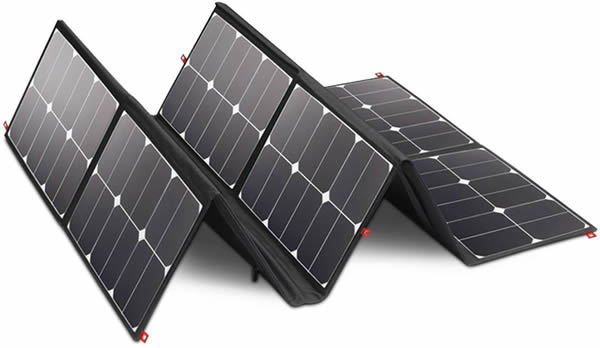 We also carry a portable 240W solar blanket with a 10 metre lead, for use if camped for an extended period under trees or in other marginal sunlight situations, or just to complement the 200W rooftop panel for longer off-grid stays.
An added benefit of a portable solar panel is that it can be set at a suitable angle and continually moved during the day to ‘track the sun’, generating maximum current output.
The electrical current generated by this blanket charges the batteries through our main onboard Redarc DC-DC battery charger. The portable panel is connected to the electrical system via an Anderson plug installed outside the van. This plug is connected to our Redarc DC-DC battery charger. We can also connect the portable panel, via a portable solar controller, to a second Anderson plug which is connected directly to the batteries.
With 440W of solar output available, this can restore up to 20 Ah per hour, or around 100 Ah per 6 hour day (in good conditions), which is ample to cover our 50 Ah of daily battery usage, and then some.
Read more: Solar Power – the Nitty Gritty >>>
More info…
|
But what if the sun isn’t shining? The next section – How Long Without the Sun? – considers how long we can continue to run our appliances (most importantly the fridge) in cloudy conditions.
Of course, there are Alternative Battery Charging Options, and some real-life practicalities to take into account when considering The Bottom Line.
Batteries | Consumption | Battery Recharging | Solar Charging | How Long Without Sun? | Alternate Charging Options | The Bottom Line