Sustainability: Batteries & Solar | Water | Heating
Batteries | Consumption | Battery Recharging | Solar Charging | How Long Without Sun? | Alternate Charging Options | The Bottom Line
Based on the information in the previous pages, let’s summarise our free-camping solar-supported electrical sustainability…..
| 1: No Sun – No Battery Charging | |
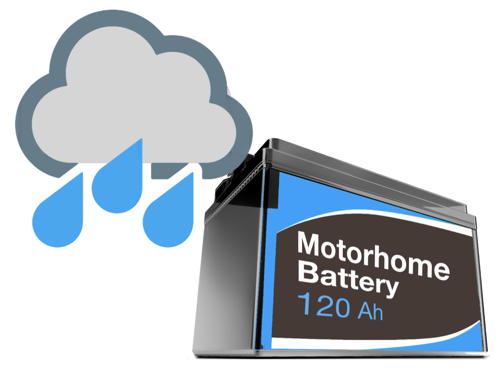 In theory: With up to 50 Ah consumption per day, and no sun, and no other battery charging options, we have about 4 days of usable power – based on zero charging input, and usable stored battery energy of 192 Ah from our 2 x 120 Ah Lithium batteries. In theory: With up to 50 Ah consumption per day, and no sun, and no other battery charging options, we have about 4 days of usable power – based on zero charging input, and usable stored battery energy of 192 Ah from our 2 x 120 Ah Lithium batteries.
Reality: We are unlikely to experience complete zero charging, but with no sun our battery capacity is likely to be exhausted after five nights. In these situations we would need to run the engine to charge the batteries from the alternator. Another real-world consideration – if we are on holidays and the weather is lousy, we are likely to be out driving the van anyway! |
|
| 2: With Sun – Charging from Roof-top solar panel | |
|
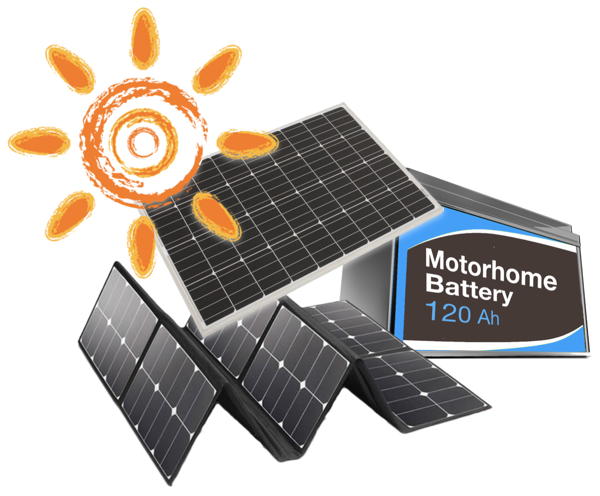
This will vary depending on the time of year / length of day. Reality: In summer, with long sunny days, and suitable solar panel positioning, we are likely to be generating at least 50 Ah per day, covering our energy consumption. In these conditions we can maintain our 12V electricity supply for many weeks. But we are unlikely to stay in the same place for that long. |
|
| 3: With Sun – Roof-top solar panel + Portable solar panel | |
|
Reality: In good summer conditions, with plenty of sunshine each day, this twin panel solar setup will provide indefinite 12V power for our needs. (We will exhaust our water supply a long time before we exhaust our 12V electricity supply. Not to mention the need to empty the toilet cassette.) We purchased a Kings 240W portable solar blanket which generates up to 10 amps output – adding up to 60 Ah energy recharge per day. Note: Advertising for this panel suggests 20 amps output. I think they are dreaming! The combined output of our 200W rooftop panel and the 240W solar blanket is around 20 amps (10 amps + 10 amps), adding 100 Ah to the battery energy storage per 6 hour day, which more than covers our 40 – 50 Ah daily usage. |
|
 In theory:
  In theory:
 What it all means…
 The previous pages provide theoretical information about the three critical 12V sustainability factors:
-
-
- battery capacity;
- appliance energy consumption;
- solar charging capacity.
-
But what does this all mean in the real world, when we are on the road?
If travelling most of the time, and only staying in an unpowered location for a couple of consecutive nights, the energy capacity of the 2 x 120 Ah Lithium batteries being charged by the vehicle alternator while travelling, and being topped up by the roof-top 200W solar panel while stationary, will be more than adequate for our needs, with average use of the 12V fridge, lights, bathroom and water pump, and sensible use of 230V appliances through an inverter.
If staying continuously in the one unpowered location in summer, with long sunny days, and sensible use of electrical appliances, the inbuilt energy storage and recharging systems will be able to maintain the electrical energy required to run the appliances in the van for at least a couple of weeks, or longer – depending on weather conditions.
Our supplementary 240W solar blanket, used in conjunction with the roof-top panel, ensures ongoing sustainable 12V power. (We will exhaust our onboard water supply long before we exhaust our 12V electricity supply.)
If staying in the one location in rainy or heavily overcast conditions for more than a couple of nights, with minimal charging and constant fridge use, 5 days will be about the maximum length of stay before the Lithium batteries approach their critical 80% discharge limit.
In this case, supplementary charging current will be required…..
-
-
- running the vehicle engine to charge from the alternator – 40 Ah / hour;
- hooking up to a 230V power supply – 25 Ah / hour;
- if there is some sunlight, connecting the external solar panel (restoring 2 – 15 Ah per hour, combined panel capacity and sun dependent).
-
If travelling off the grid for extended periods of time, and using 230V appliances every day for meals (through the inverter), we would probably be fine as we are. We could get carried away and increase our battery capacity to 2 x 200 Ah Lithium batteries (or 2 x 300 Ah batteries). This would also require an increase in our solar recharging capacity, but it is doable if needed.
More reading:
|
Batteries | Consumption | Battery Recharging | Solar Charging | How Long Without Sun? | Alternate Charging Options | The Bottom Line