 Like most Campervan travellers, we have always kept an eye on our batteries’ State of Charge (SoC), and as the price of Lithium batteries has slowly tumbled we wondered if it might be worth going for something a bit bigger in the energy storage department.
But as we have recently discovered, there are other options available to extend our off-grid electrical energy sustainability.
Turns out, it’s not all about battery capacity. Especially if you have a not-so-new van.
Out with the old, in with the new
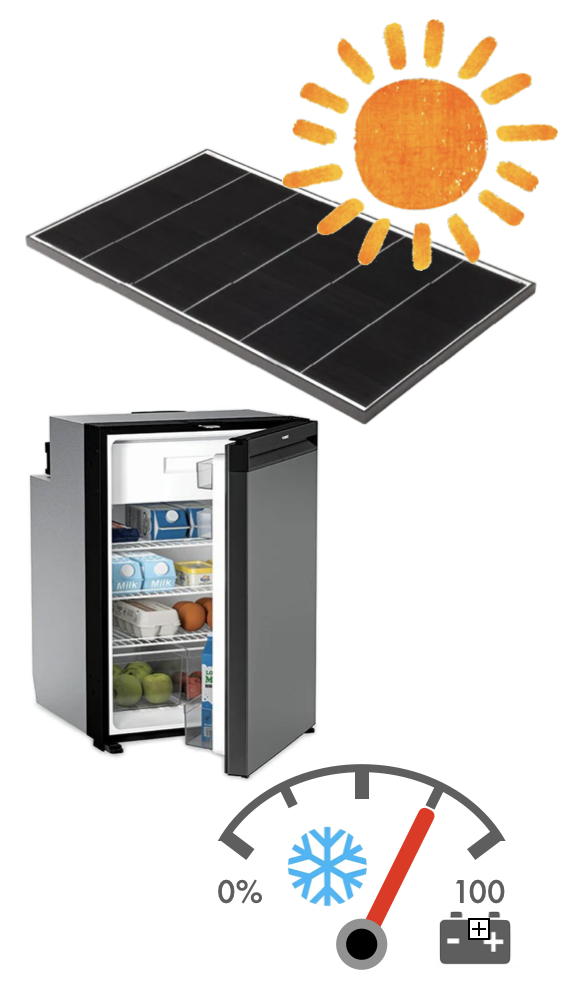 Last year our 150W Redarc rooftop solar panel failed – it was only charging intermittently due to an internal electrical fault.
With the 150W panels no longer available we replaced the failed panel with a new Redarc 200W panel. (This was a better fit on our roof than the 180W panel.)
I was pleasantly surprised at the increased output following the upgrade. The 150W panel had been pushing 6 or 7 amps to the Redarc charger on a good day, while the output from the new 200W panel is around 12 – 13 amps – double the output of the old panel. While the new panel is slightly bigger, both electrically and physically, the more recent panel technology in the cells is no doubt a factor contributing to the increased output.
At around the same time that we updated our solar panel, the latching mechanism on the door of our Dometic CRX 110 compressor fridge failed, for the second time. I was tempted to strip it down (again) and start over with more replacement parts, but there were a few other issues with the fridge. Long story short, we bit the bullet and installed a new fridge – a Dometic NRX 115 fridge, which fitted neatly in the same cupboard space as the old fridge.
Again I was pleasantly surprised after we connected it up and ran it for a couple of days. The old CRX 110 fridge was consuming around 30 Ah of stored battery energy between 6pm and 6am. The new NRX 115 fridge is consuming a relatively miserly 15 Ah during the same 12 hour period.
 So, as a result of our equipment upgrades, we have doubled our batteries’ solar charging input, while halving our discharging consumption.
We were running a net energy deficit of around 35 Ah a day with the old fridge and solar panel – which at the time we thought was pretty good – to now having a net energy excess of around 30 Ah (or more) each day with the new kit fitted. In sunny Summer weather our batteries are fully charged by mid-morning each day.
We can now stay completely off-grid indefinitely if we need to, with the same Sphere 120 Ah Lithium batteries (x2). Though in reality, being creatures of the coast, we do tend to spend plenty of time in beachside campgrounds with grid power. But it’s nice to know that that extended Nullarbor trip wouldn’t be a problem!
See also: Campervan off-grid sustainability | Solar Charging – the Nitty Gritty